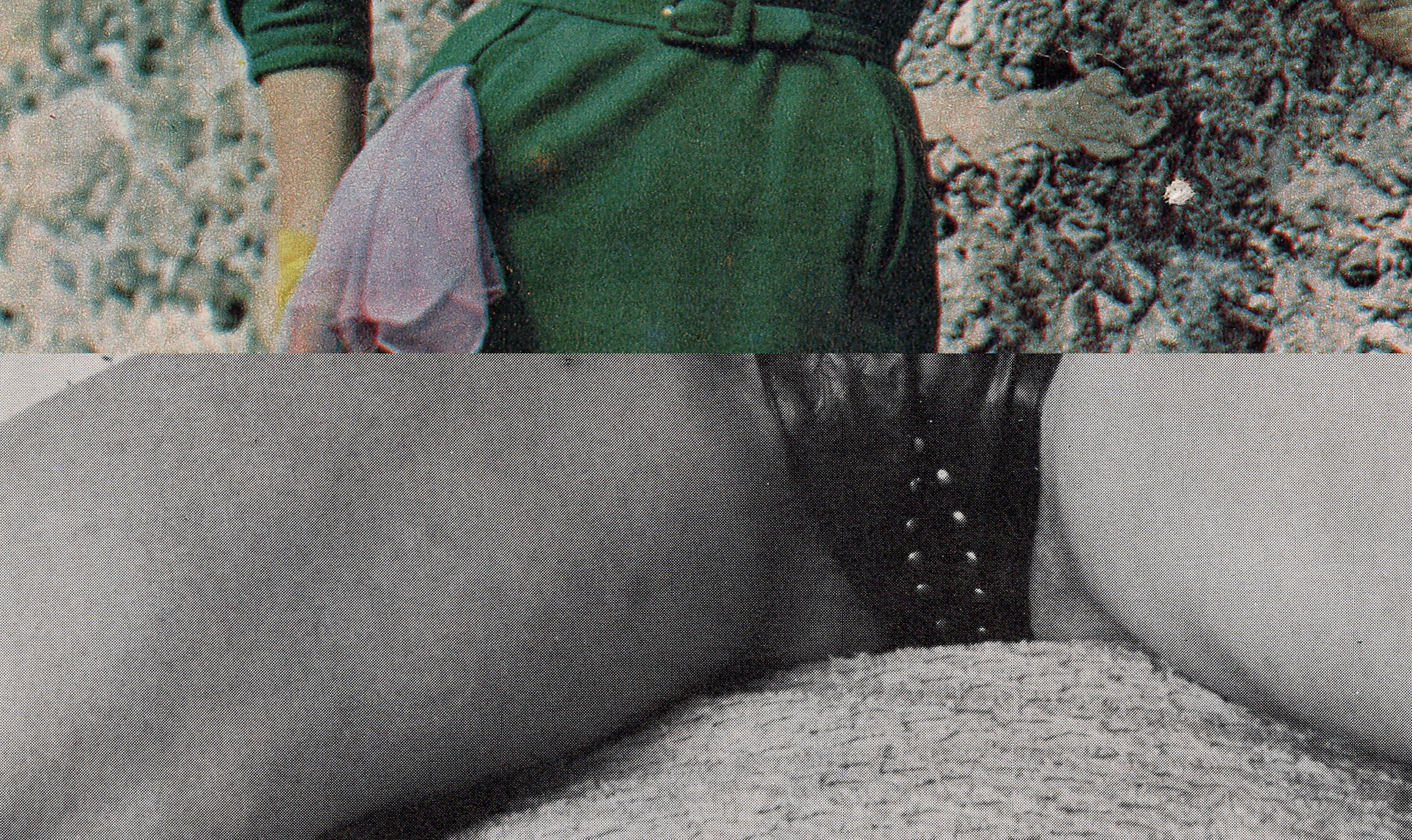
Nelly Is Looking for Closure is an ongoing artistic research project that investigates perceptual organization as a structural drive toward coherence. The project operates primarily with archival image material, understood not as historical documentation but as pre-conditioned visual matter shaped by circulation, reproduction, and cultural encoding. The archive functions as a site in which mechanisms of recognition are already active.
A recurring image fragment of a woman, referred to as Nelly, serves as a constant variable within the project. The image is never presented in full and appears only through partial exposures, fragmentation, repetition, and material translation. Nelly does not function as subject but as an operational anchor around which perceptual stabilization is repeatedly activated and suspended.
The project examines both the inner and outer construction of perception. Internally, it engages the cognitive reflex toward completion: the tendency to fill gaps, stabilize identity, and consolidate form across time. Externally, it manipulates the spatial, temporal, and material conditions that structure how images are read. Rather than fragmenting the image alone, the work also fragments the frameworks that normally render fragmentation legible. Regular spacing, rhythmic repetition, consistent scale, and predictable duration typically restore coherence even within disrupted images. By destabilizing these structuring devices, through irregular intervals, shifting scale, inconsistent exposure, material variation, and temporal acceleration or delay, the project interferes with the conditions that allow the viewer to comfortably recognize “disruption” as a coherent strategy.
Across printed image works, video, and installation, different formal procedures are staged: analysis through fragmentation, insistence through repetition, relational alignment through recombination, and temporal disruption through acceleration and delay. These procedures do not resolve the image; instead, they expose the tension between coherence as a cognitive reflex and coherence as a spatial or material construction. The viewer encounters not simply a fragmented body, but the effort of perceptual closure itself.
All works are designated as tests and numbered sequentially, including iterations that are not publicly exhibited. The numbering system does not differentiate between resolved, unresolved, or discontinued outcomes; each iteration remains indexed within the research structure. Exhibition status does not determine validity. Every test, whether presented, withheld, or materially abandoned, constitutes a recorded operation within the system. In this way, the project resists hierarchical distinction between production and discard, maintaining continuity across visible and non-visible stages of development.